What are Peptides?
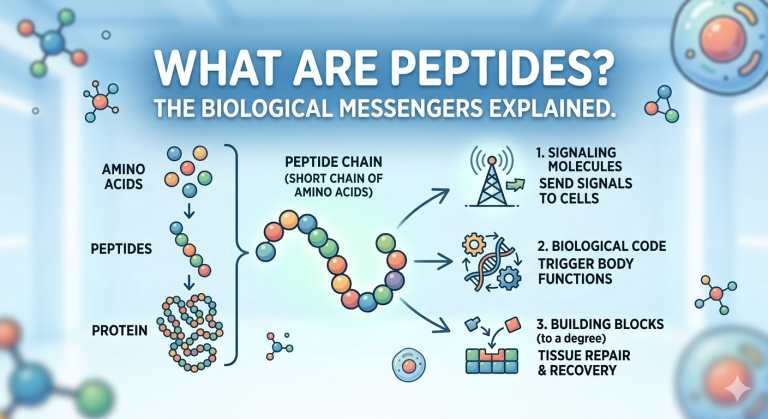
Think of peptides as biological software code. They don’t necessarily do the heavy lifting themselves; instead, they act as signaling molecules that tell your body to perform specific functions.
When a peptide binds to a cell receptor, it triggers a “command,” such as:
- “Produce more collagen to repair this tissue.”
- “Release stored fat to be used for energy.”
- “Trigger the pituitary gland to release natural growth hormones.”
- “Reduce inflammation in this specific joint.”
Key Categories in Research
Because there are hundreds of different amino acid combinations, peptides can be engineered for very specific goals:
- Repair & Recovery: Focuses on healing tendons, ligaments, and the gastric system.
- Metabolic/Weight Management: Encourages the body to prioritize fat burning.
- Cognitive/Nootropic: Targeted at brain health, focus, and neuroprotection.
- Cosmetic: Often used in high-end skincare to signal the “innate” production of collagen and elastin.
Why They Are Unique
Unlike many synthetic compounds, peptides are often bio-identical or closely mimic the sequences already found in the human body. This allows for highly targeted research with a level of precision that broader “blunt-force” supplements often lack.